Article Overview
Everyone says the AI race is the most important technology competition of our time. Fewer people explain what that race actually looks like on the ground — who is ahead, in what specific areas, by how much, and why any of it matters to ordinary people.
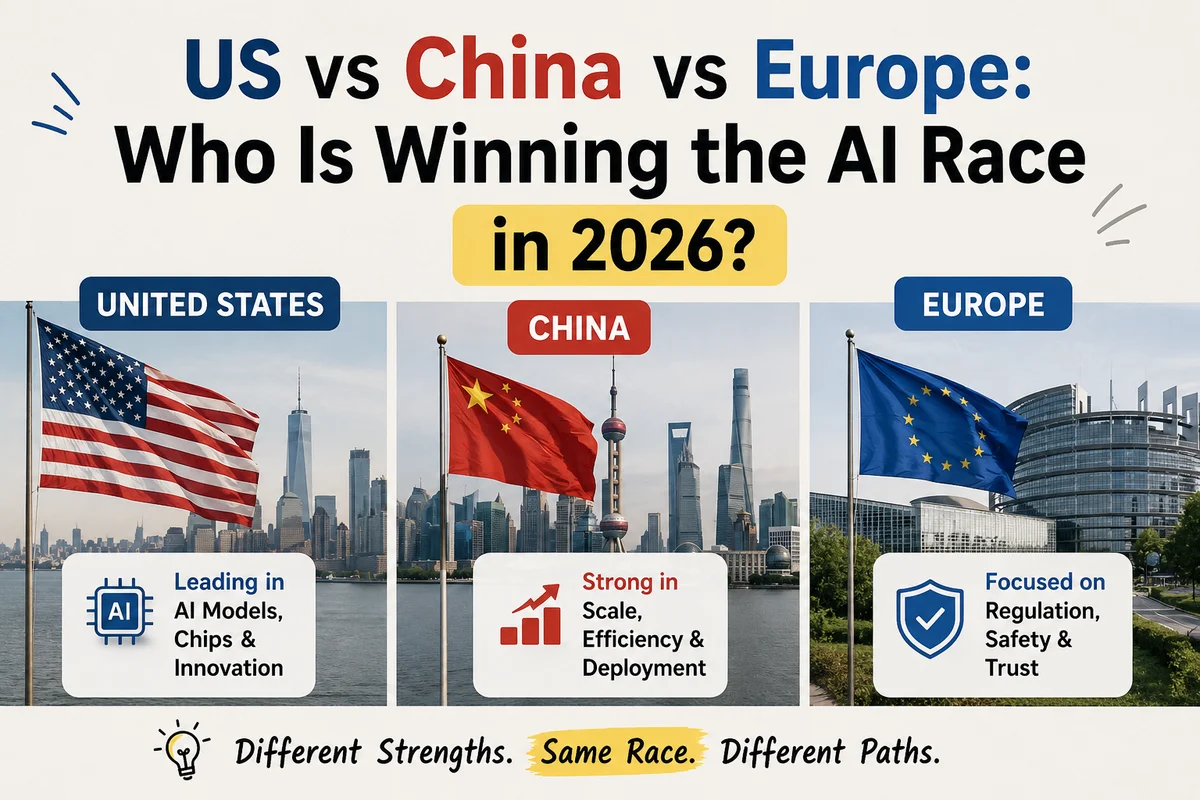
The honest answer in 2026 is that no single country is winning everything. The US has the most powerful AI models and the deepest investment. China proved in early 2025 that it can build near-frontier AI at a fraction of the cost — a revelation that shook the entire industry. Europe has neither but is doing something the other two have largely avoided: writing serious rules about how AI should work before things go wrong.
This article gives you the clearest picture available of where each region stands, what they are doing well, where they are struggling, and what the next few years could look like. No propaganda, no cheerleading — just an honest assessment of a genuinely complicated race.
Introduction
Imagine three runners in a race where each one is very good at a completely different kind of running. One sprints. One conserves energy and runs efficiently. One stops regularly to make sure the course is safe before continuing. Declaring a winner depends entirely on what you think the race is for.
That is roughly where the US, China, and Europe find themselves in AI in 2026. They are competing in the same general direction but with different strategies, different philosophies, and different definitions of what winning actually means.
The US is betting that building the most powerful AI as fast as possible is the path to long-term dominance. China is betting that efficiency and scale of deployment matter as much as raw capability. Europe is betting that AI built under clear rules and values will ultimately be the AI that the rest of the world trusts and chooses.
All three bets have real merit. All three have real risks. Here is where each of them stands right now.
The United States: Ahead on Every Frontier Metric — and Knows It
Walk into any serious AI lab discussion today and the US credentials are impossible to ignore. Every model that holds a meaningful benchmark lead in 2026 comes from an American company. OpenAI's GPT-5.6 Sol leads on coding and agentic benchmarks. Anthropic's Claude Fable 5 leads on financial reasoning and computer use. Google DeepMind's Gemini 2.5 Pro tops conversational AI leaderboards. Meta's Llama 3.1 405B is the most downloaded open-weight frontier model in history with over 350 million downloads.
Behind those models is an ecosystem that no other country has been able to replicate. NVIDIA — an American company — manufactures roughly 80% of the chips used to train and run frontier AI globally. This is not a small advantage. Chips are the bottleneck in AI development. Whoever controls chip supply controls the pace of AI progress, and the US has been tightening that control by expanding export restrictions on its most powerful hardware.
The investment numbers reflect the ecosystem's maturity. The US puts more money into AI annually than any other country by a significant margin — over $100 billion in venture and corporate AI investment in a single year. OpenAI alone is valued at $157 billion. Anthropic at $18.4 billion. Microsoft has invested more than $13 billion into OpenAI and built the technology into every major product it sells.
The talent pipeline feeds this. MIT, Stanford, Carnegie Mellon, and Berkeley produce a disproportionate share of the world's top AI researchers — and then keep them, because American AI companies offer salaries and equity that no other country's institutions can match.
In 2026, the US government has also become deeply embedded in frontier AI in ways it was not before. Anthropic built a nuclear-focused AI classifier in partnership with the Department of Energy and the National Nuclear Security Administration, deployed it on live Claude traffic, and announced plans to share the approach with the broader industry. OpenAI launched Daybreak — an AI-powered cybersecurity platform working directly with US federal agencies. When Claude Fable 5 was released in June 2026, the US government applied export controls to it within three days. The relationship between Silicon Valley and Washington is messy, sometimes contentious, but deeply intertwined in ways that give American AI a national security dimension that no other country's commercial AI has developed at the same scale.
Where the US Is Vulnerable
None of this means the US position is unassailable. The lack of comprehensive federal AI regulation is a genuine weakness — not because regulation is always good, but because the absence of clear rules creates unpredictability for businesses and leaves real harms unaddressed. The concentration of power in a handful of companies raises questions about monopolization that regulators have not seriously answered. And perhaps most importantly, China's DeepSeek demonstrated in early 2025 that the assumption of permanent US cost advantage was wrong — something we will come back to.
China: The Country That Proved Everyone Wrong About Cost
For years, the conventional wisdom was that China was a technological follower in AI — capable of building good second-tier products but not of competing at the frontier. DeepSeek erased that assumption.
In December 2024, DeepSeek released DeepSeek V3 — a 671-billion-parameter Mixture-of-Experts model trained at a reported cost that was a small fraction of what US companies spend training comparable models. In January 2025, DeepSeek R1 followed — a reasoning model that performed competitively with OpenAI's o1 on multiple benchmarks, released as open weights under the MIT license. Both were trained on chips that China was supposed to be unable to use effectively because of US export controls.
The industry reaction was not subtle. If China could build near-frontier AI at dramatically lower cost using older hardware, the US advantage in compute spending was less decisive than everyone had assumed. The financial markets responded accordingly, briefly wiping hundreds of billions from NVIDIA's valuation.
What DeepSeek proved is not that China has caught up to the US frontier — it has not, by 2026. What it proved is that efficiency innovation can partially offset hardware restrictions. China's AI companies cannot get NVIDIA's most advanced chips. So they built techniques to do more with less. That is a meaningful capability in its own right.
China's other advantages are structural. It has 1.4 billion people generating data at scale. It has a government willing to deploy AI without the legal and ethical friction that slows Western deployments. Its AI companies — Baidu, Alibaba, Tencent, Huawei, ByteDance — are enormous, well-funded, and moving fast. Kimi K2.7, a Chinese model, appears in OpenAI's own safety research as a comparison point for evaluating their models — a telling acknowledgment that Chinese models are in the reference set for frontier evaluation.
The scale of AI deployment in China's public infrastructure is also something the West has not matched. Facial recognition systems, smart city management, healthcare AI, and industrial automation run at a scale and speed in China that reflects what happens when a central government decides AI is a national priority and removes most of the obstacles to deployment.
Where China Is Constrained
The chip restrictions are real and painful even if China has partially worked around them. Training frontier models at maximum scale still requires the most advanced chips, and those chips are not available to Chinese companies. SMIC, China's most advanced domestic chip manufacturer, is still operating at process nodes that trail TSMC and Samsung by multiple generations.
Beyond chips, there is a values problem that compounds every other challenge. Every AI model deployed commercially in China must pass government review and comply with content restrictions set by the Chinese Communist Party. This is not just a political constraint — it is a technical one. A model that is required to refuse certain questions, downplay certain events, and avoid certain topics is a model with forced gaps in its capability and knowledge. And those gaps make Chinese AI significantly less appealing to the international market, which limits both adoption and the commercial revenue that funds further development.
Europe: Writing the Rules While Others Build the Tools
Europe's position in the AI race is genuinely different from the US and China, and it requires a different frame to evaluate honestly.
No European company is competing at the frontier of AI capability. The most prominent European AI company, Mistral AI in France, has raised over a billion dollars and builds competitive open-weight models, but Mistral is not in the same conversation as OpenAI, Anthropic, or Google DeepMind on raw capability. Aleph Alpha in Germany focuses on enterprise AI sovereignty rather than frontier capability. The UK has world-class AI safety research and a productive relationship with frontier labs — the UK AI Safety Institute tested Claude Fable 5 for jailbreaks, and Anthropic described its partnership with the UK government as growing and trusted — but has not produced a frontier model of its own.
What Europe has done is something the other two have not: create a serious legal framework for AI. The EU AI Act is the world's first comprehensive AI regulation, and it is now in active enforcement. It categorizes AI systems by risk level — from applications that are outright banned (like real-time biometric surveillance in public spaces) through highly regulated applications (like AI in hiring or credit scoring) to lower-risk applications that face lighter requirements. Companies operating in Europe, regardless of where they are based, have to comply.
This matters more than it initially sounds. Regulation shapes technology. The GDPR — Europe's data privacy law — changed how websites around the world handle personal data, not just within Europe. The EU AI Act is likely to have a similar effect. Companies building AI products for European markets will design them to meet European standards. Those design choices influence global products. And Europe has 450 million people, representing one of the world's largest consumer markets — companies cannot simply ignore European rules and walk away from European customers.
The UK's focus on AI safety specifically has produced the world's first government AI Safety Institute — an institution that actively tests frontier models before and after deployment. When Anthropic released Fable 5, the UK AISI was part of the red-teaming process, looking for jailbreaks. That kind of government-lab collaboration on safety testing is genuinely valuable and genuinely novel.
Where Europe Is Falling Short
The brain drain is real and serious. Some of the most talented AI researchers in the world were educated at European universities and are now working at Google, OpenAI, and Meta. The founders of DeepMind — arguably the most significant AI research organization of the past decade — were British, but DeepMind was acquired by Google in 2014. European talent is contributing enormously to American AI success.
The fragmentation problem is also real. Twenty-seven member states with different economic situations, different languages, and different priorities produce policy slowly and sometimes incoherently. What Germany prioritizes in AI policy may conflict with what France or Poland prioritizes. This is not a new problem for the EU, but it is more acute in technology than in most other policy areas.
And the fear of overregulation is legitimate. The EU AI Act is a genuine attempt to build guardrails before harm occurs. But regulations written before technology is fully understood sometimes get the rules wrong in ways that slow innovation without providing the safety benefits they were designed to create. That risk is real, and European AI companies are aware of it.
The Chip War: The Real Battlefield Underneath Everything
No analysis of the AI race is honest without a serious look at semiconductor chips, because chips determine who can build what, how fast, and at what cost.
NVIDIA's H100 and H200 data center GPUs are what the world's most powerful AI models are trained on. OpenAI's GPT series, Anthropic's Claude, Google's Gemini, Meta's Llama — all trained on NVIDIA hardware. NVIDIA controls an estimated 80% or more of the AI training chip market, and it is an American company operating under American law.
The US has been systematically restricting NVIDIA's ability to sell its most advanced chips to China. The restrictions have escalated over time, covering the A100, H100, H200, and the latest Blackwell generation. This is the single most impactful action the US government has taken in the AI competition with China.
China's response has been a combination of workarounds and domestic development. DeepSeek's training efficiency on older chips was not just an impressive technical achievement — it was a survival adaptation. When you cannot get the best hardware, you develop techniques to use the hardware you have more effectively. China's domestic chip development through Huawei (Ascend 910B series) and SMIC is progressing, but still lags the leading edge of what NVIDIA and TSMC produce.
The chip competition is, in many ways, the race underneath the race. Frontier model capability scales with compute. Compute scales with chip access. Chip access is controlled by American export policy. The country that either breaks the chip bottleneck through domestic development or finds ways around export restrictions will change the trajectory of the AI race in ways that benchmark scores on individual models currently cannot predict.
The Scoreboard: Who Leads in What
Rather than declaring an overall winner, here is an honest dimension-by-dimension comparison.
Dimension | Leader | Why |
|---|---|---|
Frontier model capability | United States | OpenAI, Anthropic, Google lead every benchmark |
AI investment volume | United States | $100B+ annually, nothing else comes close |
Talent pipeline and retention | United States | Salaries, visa access, ecosystem density |
AI chip manufacturing and control | United States | NVIDIA dominance, export restriction leverage |
Cost-efficient AI development | China | DeepSeek proved this decisively |
Scale of public AI deployment | China | Facial recognition, smart cities, industrial AI |
AI research paper volume | China | Most papers published globally by count |
AI safety regulation | Europe | EU AI Act is the world's only comprehensive AI law |
Data privacy framework | Europe | GDPR sets global standards |
AI safety research and testing | US and UK | Anthropic, OpenAI research, UK AISI |
Open-source frontier models | US and China | Meta Llama (US), DeepSeek (China) |
Consumer AI global adoption | United States | ChatGPT at 200M+ weekly users |
Industrial AI applications | Germany and Europe | Manufacturing sector AI leadership |
Three Different Philosophies, Not Just Three Different Strategies
The deeper story underneath the benchmarks and investment numbers is a philosophical divergence about what AI is for and who it should serve.
The American philosophy is essentially capitalist and optimistic: build the most powerful AI as quickly as possible, let private companies lead, minimize regulatory friction, and trust that the benefits will outweigh the harms. The results of this approach are evident in the frontier models that exist today. The risks are also evident in the concentration of power in a handful of companies and the lack of systematic protections for people harmed by AI systems.
The Chinese philosophy is essentially statist and pragmatic: AI is a tool of national power, and it should serve the interests of the Chinese state and people as defined by the Communist Party. The results include the most comprehensive deployment of AI in public infrastructure of any country in history. The risks include a system designed to surveil and control a population, and AI models constrained to avoid truths that the government finds inconvenient.
The European philosophy is essentially cautious and rights-focused: AI must be built within a framework that protects human dignity, privacy, and democratic values. The results are the world's most serious attempts to govern AI before its harms become irreversible. The risks are that Europe talks about AI rules while others build AI products, and that the continent falls permanently behind in a technology that will define economic competitiveness.
None of these philosophies is purely right or purely wrong. The world probably needs all three operating in tension with each other — American capability pushing the frontier, Chinese efficiency challenging assumptions about what is necessary, European regulation providing guardrails that prevent the worst outcomes.
What the Next Few Years Will Determine
Several things will happen over the next two to three years that will significantly change which answers feel right in this comparison.
Chips. If China successfully develops domestic chips that can compete with NVIDIA's leading edge, or if new chip architectures emerge that break the current compute scaling assumptions, the US hardware advantage weakens significantly. If US export controls remain effective and domestic chip development stalls, China's AI advancement slows accordingly.
Regulation. If the EU AI Act proves that regulated AI can still be competitive and trustworthy, other countries will adopt similar frameworks. If it proves to be primarily a burden on European competitiveness, it will be weakened or abandoned, and the cautious approach will lose credibility globally.
Efficiency vs scale. The DeepSeek question is not fully answered yet. If smaller, more efficient models continue to close the gap with much larger frontier models, the compute advantages that underpin US and China spending become less decisive. If scaling continues to be the primary driver of AI capability, the countries with the most compute stay ahead.
Geopolitical stability. The AI race is happening alongside escalating US-China tensions that extend well beyond technology. Trade restrictions, military posturing, and diplomatic friction all affect the pace of AI development and the shape of the global AI ecosystem.
Final Takeaway
There is no single winner in the AI race in 2026, and there probably will not be for the foreseeable future. The US is ahead on the dimensions that most people think of when they say "winning" — the most capable models, the most investment, the most talent, the most commercial adoption. But China has demonstrated that the race is not as lopsided as it appeared two years ago, and Europe is writing the rules that may end up mattering most to how AI actually affects ordinary people's lives.
The most honest thing that can be said about this competition is that its outcome depends on what you think AI is for. If you think AI is primarily about capability and commercial scale, the US is winning. If you think it is about efficiency and state-driven deployment at maximum scale, China is a serious competitor. If you think it is about building technology that works within human values and democratic norms, Europe is leading the only effort that takes that goal seriously.
Probably all three of those things matter. That means the race has three different leaders, each running ahead in the dimension they chose.