xAI built Grok to be the AI that lives inside the world's largest real-time information network. Here is every model they have released, what separates each one, and why the lineup matters beyond just another chatbot.
Introduction
When Elon Musk founded xAI in July 2023, the company had a clear ambition: build AI that accelerates human scientific discovery, and build it differently from the approaches taken by OpenAI, Anthropic, and Google. The result was Grok — an AI assistant with a personality, a direct line into the real-time stream of X (formerly Twitter), and a design philosophy that prioritized intellectual honesty and fewer conversational restrictions.
The name itself sets the tone. "Grok" comes from Robert Heinlein's 1961 science fiction novel Stranger in a Strange Land, meaning to understand something so deeply and completely that it becomes part of you. That framing — deep understanding rather than surface-level response — runs through how xAI describes its models.
From a scrappy first release in late 2023 to the Grok 3 generation trained on one of the world's most powerful AI supercomputers, the lineup has moved fast. This guide covers every model xAI has released, what changed between generations, and how the full picture fits together.
What Makes Grok Different From Every Other AI
Before covering individual models, three things about Grok as a platform are worth understanding because they apply to the entire lineup — not just one model.
Real-time X data. Every Grok model has access to live posts on X. This is not a feature any competitor can replicate without the same platform. While ChatGPT and Claude require web search tools or have knowledge cutoffs, Grok can answer questions about what is happening on X right now — breaking news reactions, trending topics, live sports scores, market discussions, public figures' latest statements. For any task where recency matters, this is a structural advantage.
Personality by design. xAI deliberately built Grok to be more direct, more willing to engage with edgy or complex topics, and occasionally witty in ways that enterprise-polished AI assistants avoid. There is a "fun mode" that leans further into the irreverent tone. This is not an accident — it reflects a deliberate product philosophy that AI should have a genuine voice rather than a sanitized corporate one.
The Colossus supercomputer. xAI built its own training infrastructure. Colossus, the cluster used to train Grok 3, assembled 100,000 NVIDIA H100 GPUs — one of the most powerful AI training systems ever constructed. This infrastructure investment signals that xAI is not constrained by third-party compute the way smaller AI startups are.
The Complete Grok Model Timeline
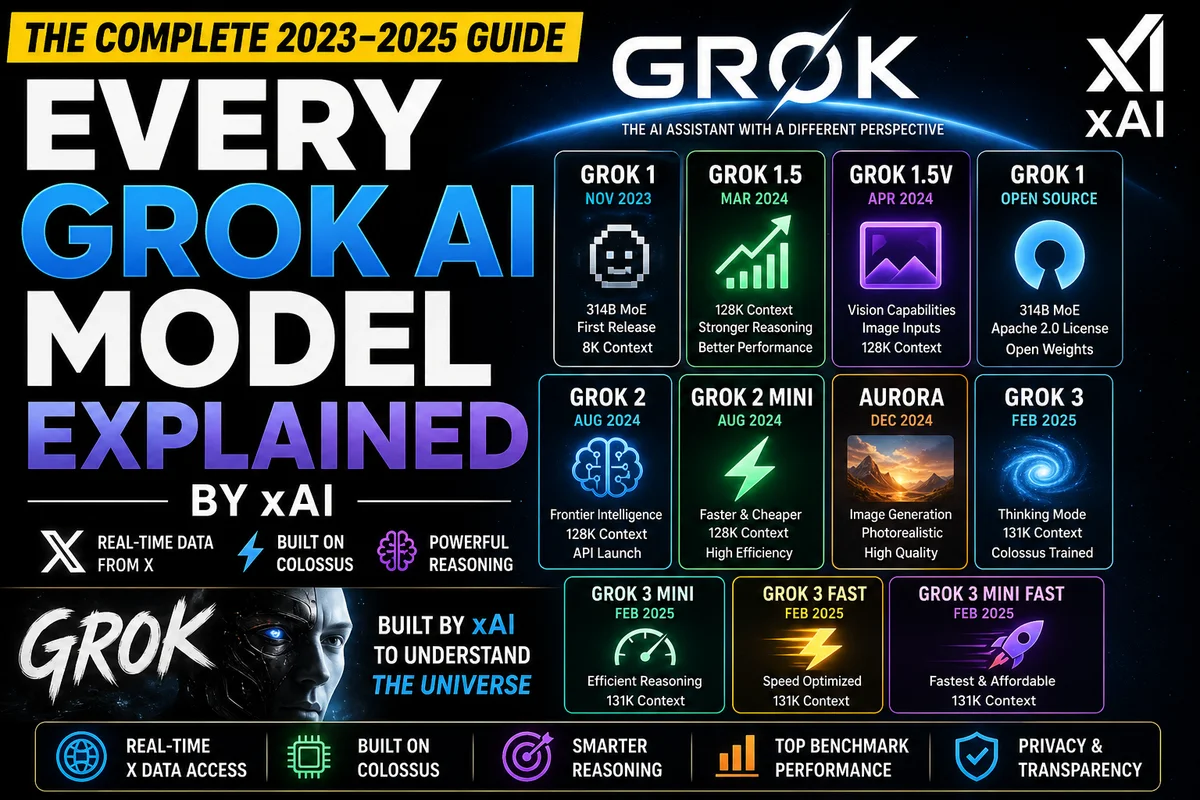
Model | Released | Context Window | Key Advancement |
|---|---|---|---|
Grok 1 | November 2023 | 8K tokens | First release, 314B MoE, X Premium+ |
Grok 1.5 | March 2024 | 128K tokens | 16x context jump, stronger reasoning |
Grok 1.5V | April 2024 | 128K tokens | First Grok with image input |
Grok 1 open-source | March 2024 | 8K tokens | Weights released Apache 2.0 |
Grok 2 | August 2024 | 128K tokens | Frontier-level, API launch |
Grok 2 Mini | August 2024 | 128K tokens | Fast, affordable Grok 2 variant |
Aurora | December 2024 | Not applicable | xAI image generation model |
Grok 3 | February 2025 | 131K tokens | Thinking mode, Colossus-trained |
Grok 3 Mini | February 2025 | 131K tokens | Efficient reasoning variant |
Grok 3 Fast | February 2025 | 131K tokens | Speed-optimized API variant |
Grok 3 Mini Fast | February 2025 | 131K tokens | Fastest and most affordable |
Grok 1 — The Starting Point
Released: November 2023 Architecture: Mixture-of-Experts (MoE) Total parameters: 314 billion Active parameters per inference: fraction of 314B (MoE design) Context window: 8K tokens Access at launch: X Premium+ subscribers only
Grok 1 arrived less than five months after xAI was founded. For a company that did not exist in early 2023, shipping a 314-billion-parameter model before the year ended was a notable pace. The Mixture-of-Experts architecture meant that despite the large total parameter count, only a subset activated for each inference call — keeping computational costs manageable while retaining broad knowledge capacity.
At launch, Grok 1 was exclusive to X Premium+ subscribers at $16 per month. This distribution strategy tied Grok directly to X's platform and revenue model — AI capability as a subscription perk, deeply embedded in the social network.
In March 2024, xAI did something few had expected: they open-sourced the Grok 1 weights under the Apache 2.0 license, releasing them on GitHub. At 314 billion parameters, it became the largest open-source MoE model released to that point. Researchers and developers could download the weights, inspect the architecture, and fine-tune it for their own purposes. The competitive and philosophical statement was clear — xAI was willing to give away its first-generation model to demonstrate openness while moving forward with more capable closed versions.
The 8K context window was Grok 1's most limiting characteristic by the standards of 2024. While competitors had already pushed toward 100K+ context, Grok 1 was constrained to documents and conversations that fit in roughly 6,000 words of content. This was addressed directly in the next release.
Grok 1.5 — The Context Window Leap
Released: March 2024 Context window: 128K tokens Access: X Premium+ subscribers
Three months after Grok 1, xAI shipped Grok 1.5 with a context window expansion that changed what the model could practically handle. From 8K to 128K tokens is not a minor upgrade — it is a 16-fold increase that moves the model from handling short conversations and documents to processing entire books, lengthy codebases, and extended research papers in a single pass.
Grok 1.5 also brought meaningful improvements in reasoning quality and factual accuracy over Grok 1. On reasoning-heavy benchmarks it moved into competitive range with GPT-4 class models that had been available for over a year — closing a gap that the first release had left open. The model remained text-only, but the foundation for the next capability addition — vision — was being built.
Grok 1.5V — First Vision Capability
Released: April 2024 Context window: 128K tokens Modalities: Text and image input Access: X Premium+ subscribers
Grok 1.5V added image understanding to the Grok lineup — the "V" designating the vision capability. The model can process photographs, charts, diagrams, screenshots, and document images alongside text, enabling tasks like visual question answering, document extraction from images, and chart interpretation.
For X users specifically, the vision capability had immediate practical value: analyzing screenshots of posts, interpreting infographics shared on the platform, and understanding visual content that made up a significant portion of what people shared on X every day. The 128K context window carried over from 1.5, maintaining the long-context capability while adding the visual dimension.
Grok 2 — Reaching the Frontier
Released: August 2024 Context window: 128K tokens Modalities: Text and image Access: X Premium subscribers, xAI API
Grok 2 was the release that positioned xAI as a genuine peer to the established frontier labs. In performance evaluations, Grok 2 competed directly with Claude 3.5 Sonnet and GPT-4o — the leading models from Anthropic and OpenAI at the time. Improvements spanned coding, mathematical reasoning, factual accuracy, and instruction following.
Two structural changes accompanied the capability upgrade. First, xAI launched the xAI API alongside Grok 2, making the model accessible to developers building third-party applications for the first time. The API uses an OpenAI-compatible format — teams already building on the OpenAI SDK could switch to Grok 2 by updating the base URL and model identifier. Second, access expanded beyond X Premium+ to include X Premium subscribers at the $8 per month tier, substantially widening the user base.
Grok 2 became the default model powering the Grok assistant embedded in the X platform, which meant it was now the AI millions of X users encountered in their daily feed.
xAI has not publicly disclosed the parameter count or detailed architecture for Grok 2, keeping the internal specifics proprietary from this generation forward.
Grok 2 Mini — Speed and Efficiency
Released: August 2024 (alongside Grok 2) Context window: 128K tokens Modalities: Text and image Access: X Premium subscribers, xAI API
Released simultaneously with Grok 2, Grok 2 Mini serves the same role that GPT-4o Mini plays for OpenAI: a faster, more cost-efficient variant of the flagship model for workloads where maximum reasoning depth is less critical than response speed and per-call cost.
Grok 2 Mini carries the same real-time X data access and vision capability as its full-size counterpart. For developers building applications that need to make frequent, rapid calls — real-time feed analysis, high-volume content processing, interactive interfaces where users expect near-instant responses — Grok 2 Mini provided a practical alternative to paying full Grok 2 pricing on every request.
Aurora — xAI's Image Generation Model
Released: December 2024 Type: Text-to-image generation Access: X Premium subscribers via Grok assistant
Aurora is xAI's image generation model, integrated directly into the Grok assistant experience on X and Grok.com. Users describe their desired image in text, and Aurora generates it. The model is known for producing photorealistic results and for applying fewer content restrictions than competing image generators like DALL-E 3 — consistent with xAI's broader philosophy of building less filtered AI tools.
xAI has not published detailed architectural information about Aurora. It is not accessible as a standalone API product in the way the language models are — it functions as a feature within the Grok interface rather than as a separately callable model endpoint.
Grok 3 — The Colossus Generation
Released: February 2025 Context window: 131K tokens Modalities: Text and image Thinking mode: Yes Training infrastructure: Colossus supercomputer (100,000 NVIDIA H100 GPUs) Access: X Premium subscribers, xAI API, Grok.com
Grok 3 represents what xAI could accomplish with purpose-built training infrastructure at a scale most organizations cannot access. Colossus — the cluster xAI assembled for Grok 3's training — brought together 100,000 NVIDIA H100 GPUs, making it one of the most powerful AI training systems ever constructed at the time of use. The compute investment is visible in the results.
On AIME 2025, the American Invitational Mathematics Examination used as a standard AI reasoning benchmark, Grok 3 scored strongly. On GPQA Diamond, which tests graduate-level science reasoning, it competed with the leading frontier models available. On coding benchmarks, it delivered results that placed it among the top tier of available models. xAI described Grok 3 as the "world's smartest AI" at launch — a claim competitors disputed, but one that reflected genuine benchmark performance rather than pure marketing.
Thinking mode is Grok 3's most significant capability addition over the Grok 2 generation. Like OpenAI's o1 series and Google's Gemini 2.5, Grok 3 can work through complex problems step by step before delivering a final answer, with the reasoning process visible in supported interfaces. For mathematical problems, scientific reasoning, and multi-step logic chains, thinking mode produces meaningfully better results than standard inference. The effort level is adjustable — users and developers can dial between faster standard responses and deeper extended reasoning depending on what the task requires.
The context window sits at 131K tokens — a modest expansion over the 128K standard established in Grok 1.5, but practically equivalent for most real-world document lengths.
Grok 3 also marked a meaningful expansion of access. Beyond X Premium subscribers, it became available on the standalone Grok.com website — accessible without an X account — and through the xAI API for developers.
Grok 3 Mini — Reasoning in a Lighter Package
Released: February 2025 (alongside Grok 3) Context window: 131K tokens Thinking mode: Yes (adjustable effort: low and high) Access: X Premium subscribers, xAI API
Grok 3 Mini carries the reasoning capability of the full Grok 3 in a smaller, faster, and more cost-efficient model. The thinking mode is present and configurable — developers can set effort to low for faster responses or high for deeper reasoning, depending on the task. For STEM tasks in particular, Grok 3 Mini's reasoning produces results that consistently exceed what a general-purpose model of similar size would deliver.
For developers building applications where the task occasionally requires chain-of-thought reasoning but full Grok 3 costs are not justified at scale, Grok 3 Mini provides an economical middle path.
Grok 3 Fast and Grok 3 Mini Fast — Speed-Optimized API Variants
Released: February 2025 Access: xAI API
Two speed-optimized variants serve the highest-throughput and lowest-latency use cases in the API lineup. Grok 3 Fast trades some quality for significantly reduced response time — suitable for real-time applications where a somewhat less thorough answer delivered instantly is more valuable than a perfect answer after a pause. Grok 3 Mini Fast is the fastest and most affordable option in the entire Grok API lineup, designed for high-volume pipelines, pre-screening tasks, and interactive interfaces where cost per call is the primary optimization target.
Complete Capability Comparison
Model | Vision | Thinking Mode | Real-time X Data | API Available | Best Use Case |
|---|---|---|---|---|---|
Grok 1 | No | No | Yes | No (open-sourced) | Research, fine-tuning base |
Grok 1.5 | No | No | Yes | No | Text tasks, long documents |
Grok 1.5V | Yes | No | Yes | No | Vision + long context |
Grok 2 | Yes | No | Yes | Yes | Frontier tasks, production apps |
Grok 2 Mini | Yes | No | Yes | Yes | High-volume, cost-sensitive |
Grok 3 | Yes | Yes | Yes | Yes | Hardest reasoning, research |
Grok 3 Mini | Yes | Yes (low and high) | Yes | Yes | Efficient reasoning |
Grok 3 Fast | Yes | No | Yes | Yes | Real-time, latency-sensitive |
Grok 3 Mini Fast | Yes | No | Yes | Yes | Highest volume, lowest cost |
How to Access Grok
Through X Platform
Free X users receive limited Grok access. X Premium subscribers at $8 per month get standard Grok access for everyday queries. X Premium+ subscribers at $16 per month receive higher query limits and early access to new model releases and features.
Through Grok.com
The standalone Grok.com web interface gives access to Grok without requiring an X account. This was introduced alongside Grok 3 and has expanded xAI's reach beyond the X user base to the broader AI tool market.
Through the xAI API
Developers can access Grok models programmatically through the xAI API at api.x.ai/v1. The interface is OpenAI-compatible, meaning existing applications built against the OpenAI SDK require minimal changes to switch. A free developer tier is available for experimentation. Pricing is per token and varies by model, with Grok 3 Mini Fast being the most affordable and Grok 3 the most expensive.
Available API model identifiers:
API Model String | Description |
|---|---|
grok-2 | Full Grok 2 |
grok-2-mini | Efficient Grok 2 variant |
grok-3 | Full Grok 3 with thinking |
grok-3-mini | Efficient Grok 3 with reasoning |
grok-3-fast | Speed-optimized Grok 3 |
grok-3-mini-fast | Fastest and most affordable |
Grok vs the Competition: Where It Stands Out
Every major AI assistant has real-time web search now. What Grok has that no competitor can replicate is real-time access to X's specific data stream — the conversations, breaking reactions, trending discussions, and real-time posts of X's hundreds of millions of users. This distinction matters most for:
News and current events queries where social reaction is as important as the event itself
Financial discussions where X serves as a leading indicator of market sentiment
Sports, entertainment, and cultural topics where real-time commentary is the substance
Tracking what specific public figures are currently saying
For pure reasoning, coding, and analytical tasks on static information, the benchmark gap between Grok 3 and competitors like Claude Fable 5, GPT-4o, and Gemini 2.5 Pro is narrow and context-dependent. No single model dominates every category. The real-time X data is where Grok offers something structurally different rather than just competitively positioned.
The Significance of Grok 1's Open-Source Release
When xAI released the Grok 1 weights in March 2024, the decision had implications beyond a single model. A 314-billion-parameter Mixture-of-Experts model with commercial-friendly Apache 2.0 licensing was the largest openly released MoE model at that point. Researchers could inspect the architecture, developers could fine-tune it, and the broader community could build on it — all without xAI's involvement or approval.
This positioned xAI differently from OpenAI (which stopped releasing open weights after GPT-2) and Anthropic (which has never released open weights). It aligned xAI more closely with Meta's approach with Llama, though xAI has not continued the practice with subsequent generations — Grok 2 and Grok 3 remain proprietary closed-weight models.
What xAI Has Not Disclosed
Honest reporting on Grok requires acknowledging what xAI has chosen not to make public. Unlike Meta's Llama releases, which come with detailed model cards and parameter counts, xAI has not disclosed:
The parameter counts for Grok 2 or Grok 3
The full architectural details of any model after Grok 1
The training data composition for any model
Specific per-token pricing for all API tiers
The benchmark results xAI publishes at launch are selected by xAI. Independent evaluations provide additional data points, but the picture is less complete than for models released with full technical documentation.
Who Should Use Grok?
X users who follow news and current events closely benefit most from Grok's real-time data advantage. If your questions frequently involve what is happening right now, Grok answers those questions in ways that other AI assistants with static knowledge cutoffs cannot.
Developers building X-integrated applications have the most natural case for the xAI API — real-time social data analysis, sentiment tracking, trend monitoring, and content moderation tools that depend on live X data.
Users who prefer a less filtered conversational AI will find Grok's personality and content policy more aligned with what they want than the more cautious tone of competitors.
Researchers and developers who want to fine-tune a large open-weight model can still work with the Grok 1 open-source release, though it is now significantly behind the current generation in capability.
For pure analytical, scientific, or coding tasks without a real-time information requirement, the choice between Grok 3 and competing frontier models like Claude Fable 5 or GPT-4o comes down to personal preference and benchmark results on specific task categories rather than a clear structural advantage for either side.
The Evolution at a Glance
In under two years, xAI moved from nothing to a Grok 3 generation trained on 100,000 H100 GPUs that competes on math, science, and coding benchmarks with the best models from organizations that had years of head start. The pace is the most striking thing about the Grok timeline — not any single model release, but the rate at which each generation improved over the last.
Generation | Key Advance | Time From Previous |
|---|---|---|
Grok 1 (Nov 2023) | First release, 314B MoE | Founded July 2023 |
Grok 1.5 (Mar 2024) | 128K context, 16x jump | 4 months |
Grok 1.5V (Apr 2024) | First vision capability | 1 month |
Grok 2 (Aug 2024) | Frontier benchmark performance | 4 months |
Grok 3 (Feb 2025) | Thinking mode, Colossus training | 6 months |
Final Takeaway
Grok is not just another AI model family with a famous backer. The real-time X data integration is a structural capability that no other AI provider can replicate. The open-source release of Grok 1 was a genuine contribution to the research community. And the trajectory from Grok 1 to Grok 3 — trained on purpose-built supercomputing infrastructure — shows that xAI is competing at the frontier, not chasing it.
The model that makes sense for any individual or organization depends on what they need from AI. For real-time information, live social data, and a personality-forward AI experience, Grok has no direct equivalent. For frontier reasoning, math, and coding on static tasks, it sits alongside the best available options rather than clearly above or below them.
Understanding all of that — which models exist, what each generation added, and where the genuine differentiators lie — is what this guide was built to provide.