
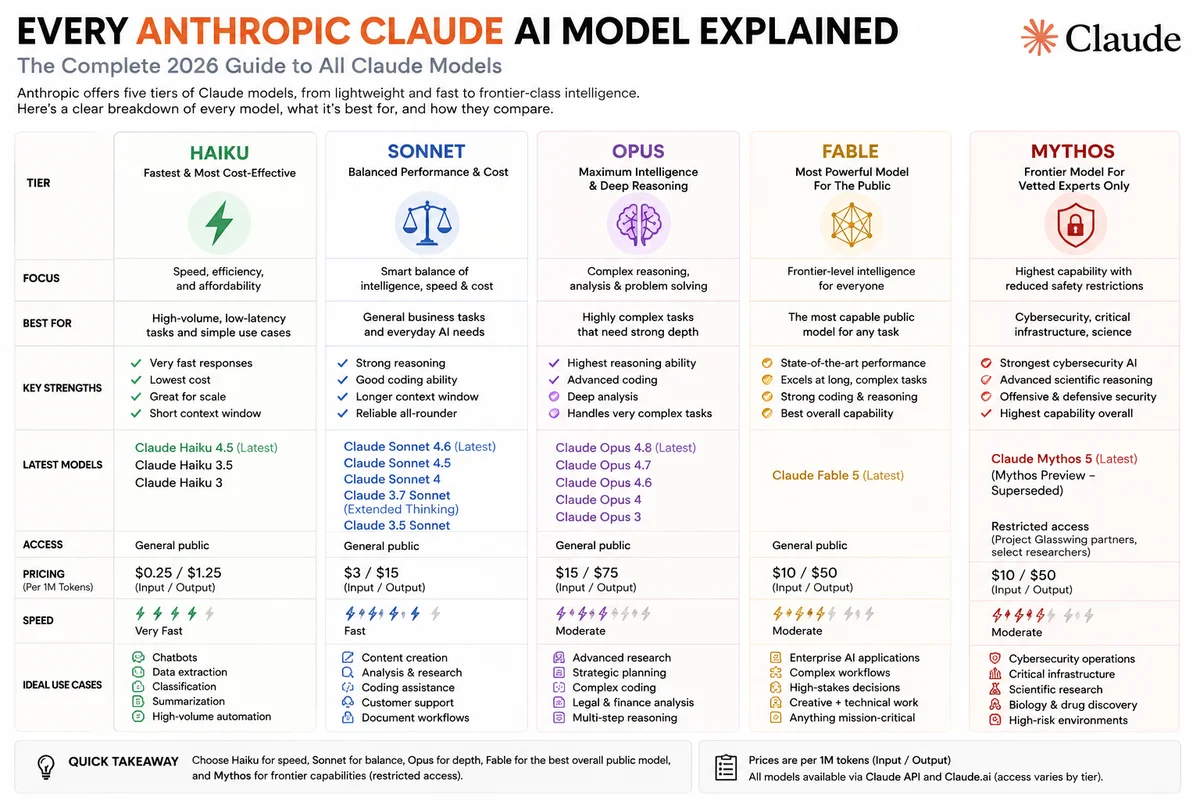
From the lightest Haiku to the most powerful Mythos 5, Anthropic now has more models than ever — each built for a different job. Here is exactly what separates them, and how to know which one you actually need.
Introduction
When Anthropic launched its first Claude model, the choice was simple. Now, in mid-2026, the lineup spans five distinct capability tiers, multiple model generations within each tier, and a new class of frontier models that not everyone can access at all. The options are powerful — and genuinely confusing if you do not know what you are looking for.
This guide covers every Claude model worth knowing, explains what changed between generations, and gives you a clear picture of which model belongs in which situation. No marketing language. Just what the models actually do, how they compare to each other, and what the differences mean in practice.
How Anthropic Names Its Models
Before diving into individual models, it helps to understand how the naming works — because it has changed.
Anthropic originally named models by family generation (Claude 3) and tier (Opus, Sonnet, Haiku). A model named Claude 3.5 Sonnet means: generation 3.5, Sonnet tier.
With the Claude 4 generation, numbering within tiers began incrementing faster — Claude Opus 4.6, Opus 4.7, Opus 4.8 represent successive refinements of the Opus tier within the fourth generation.
Most recently, Anthropic introduced a new tier above Opus entirely — called Mythos-class — with its own naming convention. Claude Fable 5 and Claude Mythos 5 are the first publicly available models in this class. The names come from their shared etymology: fable (Latin fabula) and mythos (Greek) both mean "that which is told." The safeguard differences between the two justified giving them distinct identities despite sharing the same underlying model weights.
The Five Tiers at a Glance
Tier | Models | Best For | Access |
|---|---|---|---|
Mythos | Mythos 5, Mythos Preview | Frontier science, unrestricted cyber | Restricted (vetted partners only) |
Fable | Fable 5 | Most powerful public AI tasks | General public |
Opus | Opus 4.8, 4.7, 4.6, Opus 4, Opus 3 | Complex reasoning, deep analysis | General public |
Sonnet | Sonnet 4.6, 4.5, 4, 3.7, 3.5 | Balanced performance and cost | General public |
Haiku | Haiku 4.5, 3.5, 3 | Speed, volume, low cost | General public |
Tier One: Mythos Class — The Frontier That Most Cannot Access
Claude Mythos Preview
Released: April 2026 Access: Project Glasswing only
The first model Anthropic placed above its standard Opus tier. Mythos Preview launched through Project Glasswing — a restricted program for vetted cybersecurity professionals and critical infrastructure providers. It was never publicly available. Its existence was Anthropic's acknowledgment that a capability threshold had been crossed where open release required new safeguards that did not yet exist.
Mythos Preview has since been superseded by Mythos 5 for all Project Glasswing users.
Claude Mythos 5
Released: June 9, 2026 Access: Restricted — Project Glasswing partners, select biology researchers Pricing: $10 per million input tokens · $50 per million output tokens API string: Not publicly available
Mythos 5 and Claude Fable 5 share identical model weights. They are, in every technical sense, the same model. The distinction is what the safety layer allows each to do.
Mythos 5 has its cybersecurity safeguards partially lifted for vetted partners, giving it the strongest offensive and defensive cybersecurity capabilities of any model currently available. It also has the highest-performing scientific reasoning capabilities — used for drug design (approximately 10x acceleration), autonomous molecular biology hypothesis generation preferred 80% of the time over Opus-class alternatives, and autonomous genomics research that outperformed a recent Science journal publication while being 100 times smaller.
For everyone who is not a vetted Glasswing partner or approved biology researcher, Mythos 5 does not exist as an option. For those who do have access, it represents the upper boundary of what AI can currently do.
Tier Two: Fable Class — The Most Powerful Model You Can Actually Use
Claude Fable 5
Released: June 9, 2026 Access: General public Pricing: $10 per million input tokens · $50 per million output tokens API string: claude-fable-5
Fable 5 is the most capable AI model Anthropic has ever made available to the general public. It leads on nearly all major AI capability benchmarks and operates better the longer and more complex a task becomes — a meaningful shift from previous models that degraded in quality over extended autonomous work.
What sets Fable 5 apart from everything below it:
Software engineering at scale: Stripe tested Fable 5 on a 50-million-line Ruby codebase and watched it complete a full migration in a single day — work that would have taken a full engineering team over two months. On Cognition's FrontierCode benchmark, Fable 5 scored highest among all frontier models even at medium effort.
Financial reasoning: On Hebbia's Finance Benchmark for senior-level analytical work, Fable 5 achieved the top score across all models tested, with the biggest gains in document-based reasoning and chart interpretation. IMC tested it across their full trading-analysis evaluation suite and reported near-perfect performance.
Vision: Previous Claude models needed a complex helper harness just to make meaningful progress in Pokémon FireRed. Fable 5 completed the game from start to finish using raw game screenshots and nothing else — no maps, no navigation aids, no auxiliary tools. This is a practical demonstration of how far ahead Fable 5's vision capabilities sit from its predecessors.
Long-context and memory: In tests using the game Slay the Spire, providing Fable 5 with persistent memory improved its performance three times more than the same setup improved Opus 4.8. Fable also reached the game's final act three times more frequently.
The safeguard layer: Fable 5 carries three built-in safety classifiers covering cybersecurity, biology and chemistry, and model distillation attempts. When any of these trigger, the request is handled by Claude Opus 4.8 instead. Users are informed when this happens. In practice, fewer than 5% of Fable 5 sessions trigger any fallback at all.
The pricing shift: At $10 per million input tokens and $50 per million output tokens, Fable 5 costs less than half of what Mythos Preview cost — making frontier-level AI meaningfully more accessible than it was two months ago.
Tier Three: Opus Class — The Deep Thinker for Complex Work
The Opus tier is Anthropic's highest capability tier within the standard, unrestricted model lineup. Opus models are built for tasks that require deep reasoning, long-form analysis, nuanced writing, and sustained attention across complex problems.
Claude Opus 4.8
Released: 2025–2026 (part of Claude 4 generation updates) API string: claude-opus-4-8Access: General public
The current flagship of the standard Opus lineup and, until Fable 5, the most capable publicly accessible Claude model. Claude Opus 4.8 is also the model Fable 5's safety classifiers fall back to when a flagged request is detected — a signal of how capable Anthropic considers it in absolute terms.
Opus 4.8 sits at the top of the publicly usable model stack for anyone who needs Opus-tier capability without being on a Fable 5 subscription or API plan. It handles complex multi-step reasoning, long-form research synthesis, intricate coding tasks, and detailed analytical work across extended context windows.
Claude Opus 4.7 and Opus 4.6
API strings: claude-opus-4-7 · claude-opus-4-6Access: General public
Successive refinements within the Opus 4 generation. Opus 4.7 appears in jailbreak resistance comparisons in the Fable 5 announcement — Fable 5's cyber safeguards were confirmed to be more robust than those of both Opus 4.7 and 4.8. Opus 4.6 is notable as the model that explicitly does not carry blocking cybersecurity safeguards, making it more permissive for security-related research tasks within standard policy limits.
Both remain fully available and are appropriate choices when slightly lower cost than Opus 4.8 is acceptable, or when specific API integrations require pinned model versions.
Claude Opus 4
Released: May 2025
The original Claude 4 generation Opus release. A major capability step from Claude 3 Opus, with significantly stronger coding, reasoning, and agentic task performance. Introduced improved autonomous workflow capabilities that became the foundation for the subsequent 4.x refinements.
Claude Opus 3
Released: March 2024
The model that established Anthropic's reputation for frontier-level intelligence in the Claude 3 generation. At its launch, Claude 3 Opus was competitive with the best available models from any lab on complex reasoning and knowledge tasks. Its 200,000-token context window was among the largest available at the time. Now superseded by the Claude 4 family for most serious use cases, but remains a reference point for how far the Opus tier has advanced in roughly two years.
Tier Four: Sonnet Class — The Workhorse Most Teams Actually Deploy
If Opus is for depth and Haiku is for speed, Sonnet is for everything in between — which, in practice, covers the majority of real-world AI workloads. The Sonnet tier has the largest user base of any Claude tier and has historically represented Anthropic's best effort to balance intelligence with cost and latency.
Claude Sonnet 4.6
API string: claude-sonnet-4-6Access: General public
The current standard Sonnet model and the version powering this conversation. Sonnet 4.6 handles coding, writing, analysis, document processing, and general-purpose reasoning at a level suitable for most production workloads. It delivers strong performance across a wide range of tasks without the cost of Opus-tier models.
Claude Sonnet 4.5 and Sonnet 4
API string (Sonnet 4): anthropic.claude-sonnet-4-20250514-v1:0Access: General public
Sonnet 4 launched alongside Opus 4 in May 2025, bringing the hybrid reasoning capability introduced in Sonnet 3.7 forward into the Claude 4 generation. Sonnet 4.5 is a subsequent refinement. Both handle multimodal inputs (images + text), code generation, and analytical tasks well. Sonnet 4 supports up to 20 images per multimodal call — a constraint that matters for document processing pipelines working with large scanned PDFs.
Claude Sonnet 3.7
Released: February 2025
The most important Sonnet release in the Claude 3 generation, and the model that introduced extended thinking to the Claude family. Extended thinking allows the model to work through a problem step by step before delivering a final response — visible chain-of-thought reasoning that dramatically improves performance on problems requiring multi-step logic, mathematics, and complex coding.
At its release, Claude Sonnet 3.7 was the strongest Claude model for software engineering, surpassing competitors on the SWE-bench benchmark used to measure AI performance on real-world software tasks. Extended thinking made the Sonnet tier genuinely competitive with Opus for certain types of problems — an important shift in the tier's positioning.
Claude Sonnet 3.5
Released: June 2024 (updated October 2024)
The breakout Sonnet. Claude 3.5 Sonnet became the most widely used Claude model after its release, driven by its combination of strong coding performance, natural writing quality, and speed. It topped coding benchmarks at launch and remained the default recommendation for most developers and knowledge workers well into 2025. The October 2024 update added computer use capabilities, allowing the model to interact with desktop environments. Still a capable and cost-effective option for many tasks.
Claude Sonnet 3
Released: March 2024
The original Sonnet within the Claude 3 family. Positioned as the balance between Claude 3 Opus (most capable) and Claude 3 Haiku (fastest). Solid general-purpose performance for its time, now largely superseded by the 3.5 and 4 generation models.
Tier Five: Haiku Class — Speed, Volume, and Efficiency
Haiku models are built for situations where response time and cost matter more than maximum depth. They are not simplified versions of smarter models — they are purpose-optimized for high-throughput and latency-sensitive applications.
Claude Haiku 4.5
API string: claude-haiku-4-5-20251001Access: General public
The current Haiku model. Fast, lightweight, and cost-effective — designed for applications that need to handle large volumes of requests without the latency or cost of larger models. Suitable for customer-facing chatbots, document triage, real-time summarization, classification tasks, and any workflow where speed and scale take priority over maximum analytical depth.
Claude Haiku 3.5
Released: November 2024
A meaningful upgrade over Haiku 3 in the Claude 3.5 generation. Claude 3.5 Haiku achieved something notable: near-Claude 3 Opus-level intelligence at Haiku-class speed and price. For developers building high-volume applications who previously had to choose between a fast-but-limited model and a capable-but-slow one, Haiku 3.5 narrowed that gap substantially.
Claude Haiku 3
Released: March 2024
The original Claude 3 Haiku. Designed from the start for near-instant responsiveness. Its role was to give developers and applications a Claude-quality model that could respond in milliseconds rather than seconds — opening up use cases in real-time interfaces, quick lookups, and high-frequency automation where longer-running models simply could not keep up. The foundation that made the Haiku tier a distinct and important part of the Claude lineup.
How the Models Compare: Capability vs Cost vs Speed
Model | Capability | Speed | Cost | Best Use Case |
|---|---|---|---|---|
Claude Mythos 5 | ★★★★★ | Fast | $10/M in · $50/M out | Restricted: cyber, drug design, frontier science |
Claude Fable 5 | ★★★★★ | Fast | $10/M in · $50/M out | Complex engineering, analysis, vision, long tasks |
Claude Opus 4.8 | ★★★★☆ | Moderate | Higher than Sonnet | Deep research, complex reasoning, long-form work |
Claude Opus 4.7 | ★★★★☆ | Moderate | Higher than Sonnet | Complex tasks, less restricted cyber queries |
Claude Sonnet 4.6 | ★★★☆☆ | Fast | Mid-range | Everyday coding, writing, analysis, production apps |
Claude Sonnet 3.7 | ★★★☆☆ | Moderate | Mid-range | Multi-step reasoning, math, extended thinking tasks |
Claude Sonnet 3.5 | ★★★☆☆ | Fast | Mid-range | Coding, writing, general enterprise workloads |
Claude Haiku 4.5 | ★★☆☆☆ | Fastest | Lowest | High-volume, real-time, customer service, triage |
Claude Haiku 3.5 | ★★☆☆☆ | Fastest | Lowest | Fast apps needing Opus-3-level reasoning at scale |
Which Model Should You Actually Use?
The right Claude model depends entirely on what you are trying to do. Here is a practical guide:
You need the absolute best performance and cost is secondary: → Claude Fable 5. It leads on nearly every benchmark and handles tasks no previous public Claude model could manage.
You need powerful reasoning and Fable 5 is not on your plan yet: → Claude Opus 4.8. The strongest standard model available, and the one Anthropic trusts to handle Fable 5 overflow.
You are building a production application and need the best balance of quality and cost: → Claude Sonnet 4.6. The most widely used Claude model tier for a reason — capable enough for most real workloads, fast enough for interactive applications.
You need multi-step reasoning or visible chain-of-thought: → Claude Sonnet 3.7 introduced extended thinking. Sonnet 4.x carries this capability forward.
You are building something high-volume — a chatbot, document classifier, real-time tool: → Claude Haiku 4.5. Built for speed and throughput at the lowest cost point.
You need cybersecurity or frontier science capabilities beyond standard limits: → Claude Mythos 5 — but access requires vetting through Project Glasswing or the biology trusted access program. Not available for general applications.
You are processing large batches of documents and want to minimize AI costs: → Claude Sonnet 4 via Amazon Bedrock's batch inference pipeline cuts costs by 50% vs on-demand inference while using the same model.
The Bigger Picture: How Anthropic's Model Strategy Has Evolved
In March 2024, Anthropic launched three Claude 3 models simultaneously — Haiku, Sonnet, and Opus — representing a clean capability ladder with a clear value proposition at each rung. The strategy was straightforward: one family, three tiers, choose your position on the speed-versus-intelligence spectrum.
By mid-2026, that structure has become considerably more complex. Within each tier, multiple generation variants now exist. A new class sits above Opus entirely. And the top of that class is split into two versions of the same model — one available to everyone and one reserved for organizations Anthropic has vetted and approved.
This evolution reflects something real about where AI development currently stands. The capability gap between tiers has widened, particularly at the top. The tasks Fable 5 and Mythos 5 can accomplish — autonomous multi-week scientific research, codebase-wide migrations in a single day, vision-only game completion — were not possible at any tier two years ago. As those capabilities have grown, so has the need for infrastructure around access and safety.
For most developers and businesses, the practical choice remains within the Sonnet-to-Opus range. Fable 5 is the right answer for the most demanding tasks. And Mythos 5 exists as a signal of where the frontier is heading, even if most people will never interact with it directly.
Final Takeaway
Anthropic's model lineup in 2026 is the broadest and most capable it has ever been. From Haiku 4.5 — designed for speed and volume at the lowest cost — to Fable 5 and Mythos 5 at the frontier of what AI can currently do, there is a Claude model calibrated for almost every use case and budget.
The key is matching the model to the task. Overpaying for Opus when Sonnet handles the job wastes budget. Undershooting with Haiku when a task demands real reasoning produces poor results. And for the small number of applications where frontier-level capability matters — particularly in software engineering, financial analysis, vision tasks, or scientific research — Fable 5 represents a meaningful leap over everything that came before it.
The lineup will keep growing. Anthropic has already indicated that more capable models are arriving in the coming months. But for now, this is the full picture — every Claude model, what it does, and where it belongs.